From The Archive: Feliz Cumpleaños Lobos Mexicanos!
Updated: Apr 29
By Kay Priest, former Wolf Haven Board President
Published in Wolf Tracks vol. 13, no IV
Fall 1996
Editor's Note: Each year, the last week of March is designated as "Lobo Week" to mark the anniversary of Mexican wolves being reintroduced to the wild in 1998. We celebrate Lobo Week by sharing information about "el lobo" and the efforts being made to successfully restore this critically endangered wolf to their ancestral home in the wild. This year, we have taken a look back through Wolf Haven's archives to share the story of the first Mexican wolf pups born in our sanctuary, back in 1996. We hope you enjoy reading about this significant milestone in Wolf Haven (and Mexican wolf) history!

It is with great pride and an incredible sense of accomplishment that I bring you the news of the four Mexican wolf [pups]... born at Wolf Haven this spring. Sometime in mid-to-late May, with little fanfare, Mexican wolf [M131] and [F127] produced their first ever litter of [pups] – two males and two females. In fact, it was several weeks after the actual birth before we humans were even aware that this had occurred!
[The fact] that a litter was produced this year was somewhat of a miracle in and of itself, as the parents had only met each other for the first time on February 8 [1998], a mere three months before they became a family! To add to this amazing accomplishment, the parents managed to [then] keep their offspring hidden from view for more than two months before [an] animal care staffer... first noticed a pup sitting in a small clearing in the west enclosure.
The difficulty in observing the pups demonstrates that Wolf Haven has provided the optimum captive breeding environment for these rare and precious canids. It also means that the adult wolves are properly teaching their young the importance of avoiding contact with humans – a survival skill that will serve them well when they are, we hope, introduced to the wild in the future.


Wolf Haven International proudly became a cooperative partner in the Mexican Wolf Species Survival Program in 1994. Two state-of-the-art captive breeding enclosures were built for the wolves in a secluded area of our sanctuary. In May 1994, we received two juvenile males. Two young females joined them later [that] year, in hopes that [pups] would be born in the spring of 1995...
[However], at the [1995] Captive Management Group meeting held in Battle Creek, Michigan, it was decided that our two females were too genetically unique, and therefore too genetically precious, to risk losing if released to the wild. Plans were made to rotate our females a few months later, as soon as new enclosures were completed at another participating facility. Generally, whenever moves are deemed necessary, every attempt is made to do this in the fall [in the hopes] that [it] will allow the pair to bond for several months before the female goes into estrus in late winter. [But] as often happens with even the best of plans, there were construction delays at [the partner] facility. On November 16, 1995, [F144] was flown to the Minnesota Zoological Gardens. [F127] was received in her place on February 6, 1996 [and] she was released into the enclosure with [M131] on February 8. With her late arrival, hopes for [pups this spring] were few, [but we were] ever delighted to discover that they beat the odds!
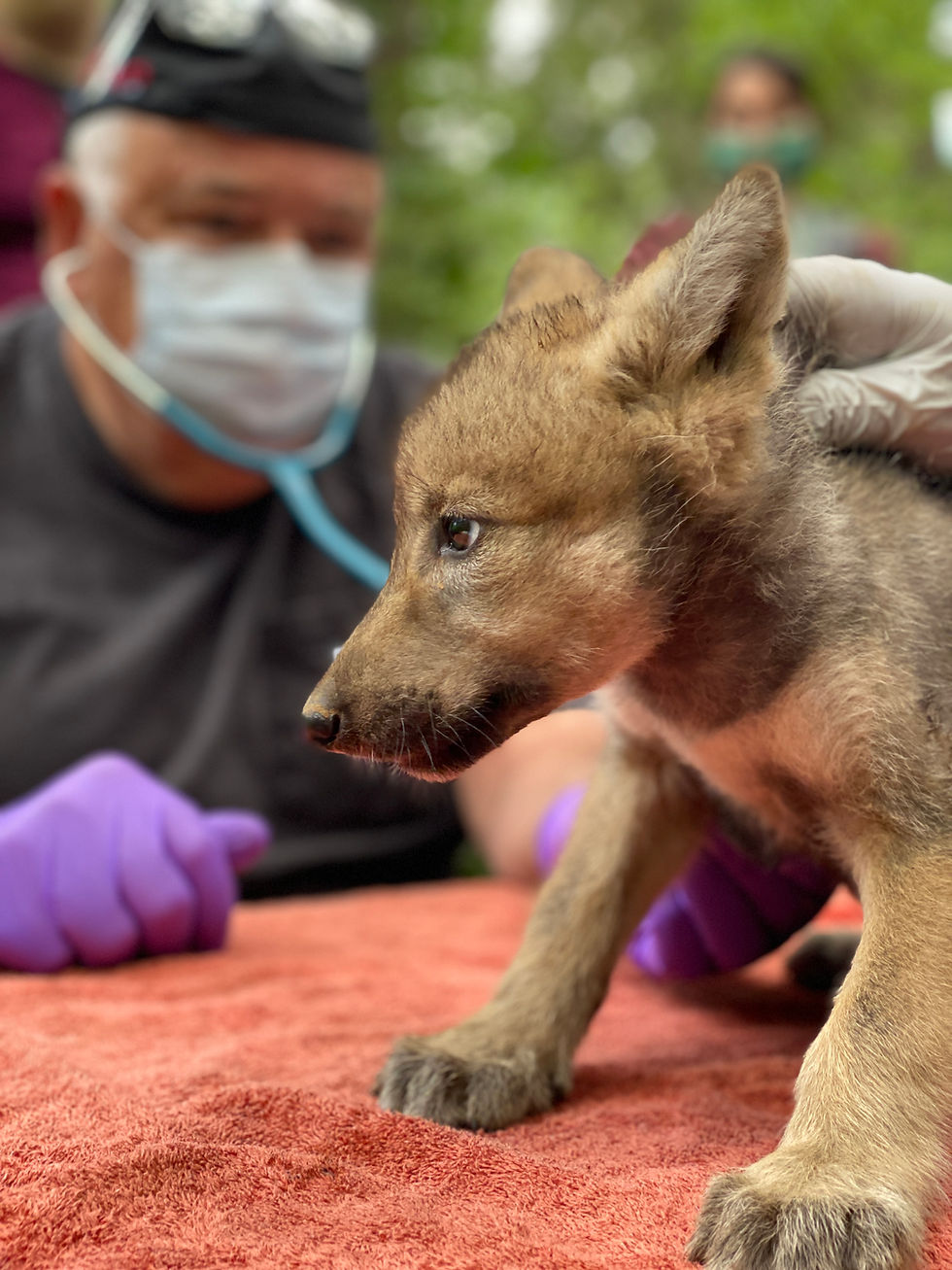
After [we] caught a brief glimpse of two [pups], [we] contacted Kent Newton, Animal Husbandry Coordinator [at] Rio Grande Zoological Park, with the news [so we could] request... a team to enter the enclosure to conduct a thorough search... A group of nine people gathered at the entrance of the enclosure early in the morning of June 30 with high hopes, radios, and capture nets. The next two and a half hours were clearly one of the high points of my life!
The first task at hand was to separate the adults from their young. The plan was to entice them into the adjoining holding area where they could be secured long enough for us to locate, examine, and vaccinate the [pups]. This part of the plan went like clockwork – as soon as Jack and Jerry Brown, D.V.M., entered the enclosure, the adults ran into the holding [area], and the gate was closed, keeping them safely away from the rest of the activity.
While we were expecting only two [pups], we were ecstatic when our considerable search efforts resulted in finding four! All appeared to be in extremely good health and all seemed to be appropriately peeved at being handled by humans. [Dr. Brown performed examinations, inserted identification chips, and administered the first series of vaccinations on all four pups before they were released back in with their parents.]

Of the many wonderful accomplishments I’ve witnessed in my ten years as a volunteer at Wolf Haven, none has ever come close to invoking the emotional intensity I experienced that day. This wolf pack will stay with us for at least another year and, most likely, the family will grow with another litter next spring. If the Final Environmental Impact Statement is approved (and adequate funding is appropriated this fall), there’s every likelihood that this wolf family will then be transferred in the fall of 1997 to the new pre-release holding and conditioning facility in New Mexico. The ultimate goal would be to release the entire family together to their new home in the wilds of the southwest.
Thanks from the bottom of my heart goes out to each of you, as it is only your continuing support of Wolf Haven that has allowed us to be such a vital part of this important program. It is very gratifying to know that so many people care enough to help in whatever way they can to restore the balance in nature.
What happened after this story was published?
In 1998, three packs of Mexican wolves were released into Arizona’s Apache National Forest after being absent from the wild for nearly 30 years. One of those packs — the Hawk’s Nest pack — came from Wolf Haven and included M131, F127, and four of their offspring. They successfully hunted an elk in less than a week and two years later, produced the first litter of pups conceived and born in the wild since their near-extinction decades earlier.
In 2000, another pack from Wolf Haven — known as the Cienega pack — was transferred and released into the wild in Arizona. A third pack release from Wolf Haven took place in 2016, as animal care team members Wendy Spencer & Pamela Maciel Cabañas transported 11 Mexican wolves from Washington into the mountains of northern Mexico.
Wolf Haven International is proud to be a part of the Saving Animal From Extinction program (formerly Species Survival Plan program) for the Mexican wolf, which is a federally-managed cooperative effort between the U.S. Fish and Wildlife Service, the Association of Zoos and Aquariums, and conservation organizations. We have participated in the Mexican Wolf Recovery Program since 1994 and the American Red Wolf Recovery Program since 2003. To learn more, visit wolfhaven.org/conservation/safe


